Winter offices and air-conditioning damage
Recycled air is the fifth Australian climate. It cracks hands in Brisbane and tightens faces in July boardrooms. Here is how to work in it without a saga.
Mara Keating · · 10 min read
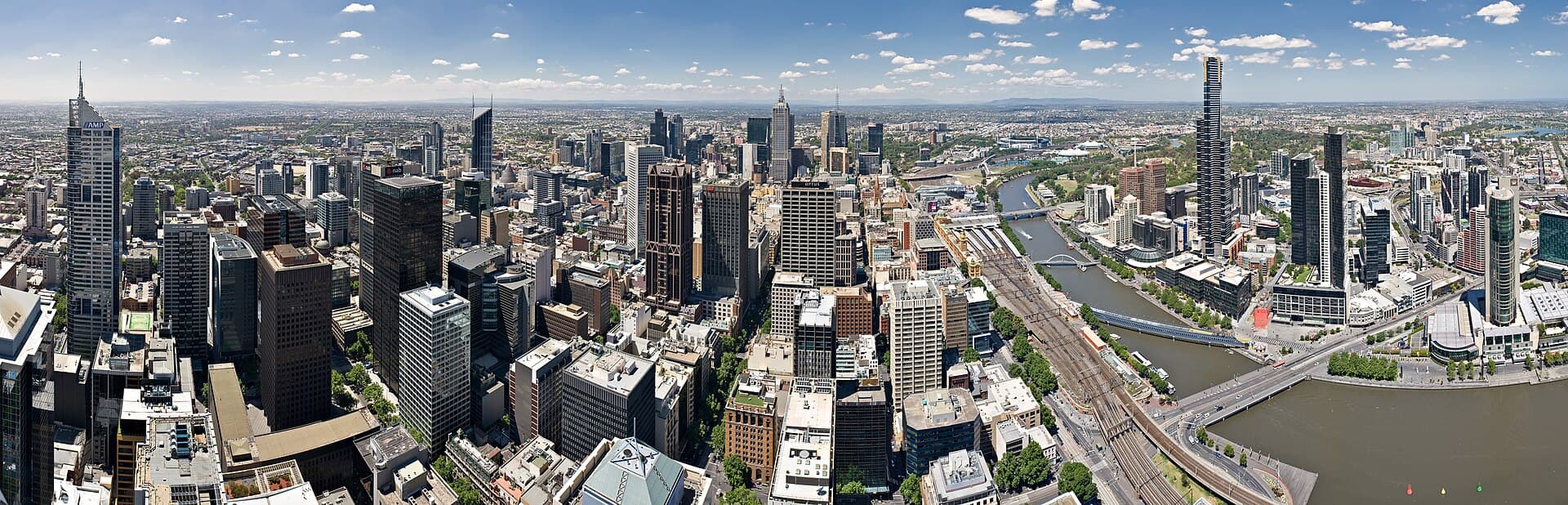
Image: Melbourne Skyline from Rialto Crop — Diliff, CC BY-SA 3.0. See all image credits.
Melbourne in July can be 11 degrees on Collins Street and 21 degrees at a desk under a vent that has not been kind since the building opened. Brisbane in January can be a steam bath on the pavement and a meat locker in a planning meeting. Air-conditioning is not a comfort feature. It is a climate with a remote control, and it is the reason a man who "never had dry skin" suddenly has paper hands and a forehead that stings after a shave.
The original eshu pitch assumed outdoor harshness — sun, wind, the dry continent. The modern version of that pitch has to include the indoor desert we pay rent to sit in.
What recycled air does to a face
Air-conditioning and heating lower relative humidity. Water leaves the skin to equalise with the room. The process is slow, which is why you notice it at 3 p.m. and not at 9.10. Eyes go first for contact-lens wearers. Then the sides of the nose. Then the backs of hands, which meet soap, paper and keyboards.
Add the behavioural pile-on. More coffee. More handwash. A lunchtime walk that includes UV you forgot because the office felt like winter. A beard that dries at the ends and itches at the neck. None of this is mysterious. It is building services plus habit.
If you want the outdoor half of the story, read dry inland air versus coastal humidity. The office is inland-on-a-timer.
A desk-level protocol
Sit out of the jet. If you can move a metre off the vent, do. People have ended marriages over thermostat wars; you can at least move a chair.
Moisturise like you commute. Morning cream before you leave. A small tube in the drawer for after lunch washing. Night cream that is heavier than your summer gel. This is not a twelve-step. It is two textures and a memory.
Hands are the tell. A bland cream after every wash sounds monastic until you count how often a workplace sink happens. Keep the tube where the soap is. If you work a trade between meetings, read skin on the tools.
Do not strip at dawn to feel clean. A squeaky face at 7 a.m. is a face that will be tight by the stand-up. Rinse, or a mild cleanser, then cream. Save the thorough wash for the end of the day when the sunscreen and the city are actually on you.
UV still exists between the foyer and the tram. Pair this piece with the daily moisturiser habit. The office does not cancel the walk.
The open-plan specials
Shared taps run hot and the soap is cheap. That combination is a dermatitis machine. If your finger webs crack, you are not "getting old". You are reacting to sodium lauryl sulfate and friction. A cotton under-glove for cleaning jobs, a fragrance-free cream, and a willingness to look slightly fussy at the basin will save you a GP visit. If it does not — if the skin weeps or keeps splitting — go. When to see a GP is not written for hypochondriacs.
Lip balm is not childish in an office that tastes of toner dust. Use one without peppermint if you lick it off every twenty minutes. Licking is the other half of the problem.
Travel between buildings
The worst winter day is not the coldest. It is the one where you walk from a heated foyer into a wind that feels personal, then into a taxi that is trying to simulate Queensland. Each transition is a demand on the barrier. A cream that can sit through those changes — not a mist, not a toner pad — is the tool.
This is why the old eshu bottles were unapologetic about being moisturisers rather than "essences". The job is to stay.
What we will not recommend
A desktop humidifier that grows something in a week. A "detox" facial in your lunch break. A new serum because the office lights are "ageing" you. Lights are not ageing you. UV and cigarettes and time are ageing you. The office is drying you.
If you manage a team, put decent soap in the amenities and a pump of plain cream next to it. You will prevent more knuckle drama than a fruit box ever did.
The simple regime still fits in a drawer: cleanser, cream, sunscreen. The building will not change. Your lunchtime habits can.
Working from home is still a climate
A spare room with a split-system and a closed door is an office. The same vent physics applies. So does the same habit of washing more because the kitchen is eight metres away. Keep a tube at that sink. Open a window when the air outside is actually kinder than the air you paid to refrigerate.
Hybrid weeks confuse skin because the insults change on Tuesdays. Pack the cream as if you were packing a charger. If you can see your face in a laptop and it looks tired, it may be tired. It may also be dry. The cheaper experiment is the cream.
A week of doing it, not decorating it
The useful test is seven days, not a new bottle. Write the weather in the morning — hot, dry, humid, recycled — and match the texture you already own. If you add anything, add it on day one only, and leave the rest of the cabinet alone so you can tell what changed.
Keep a photograph in the same bathroom light on day one and day seven. Not for social media. For honesty. Tightness, shine, a rash, a nick that will not settle: those are data. If the week is worse, stop the new thing. If the week is calmer, you have a habit, not a personality.
Carry the smallest version of the habit out of the house. A cream in a bag beats a perfect bathroom you do not visit at lunch. A hat on the seat beats a speech about UV. A hose, a tap, a rinse: the unglamorous verbs still do the work the aisle keeps trying to rename.
Tell one other person the plan if you live with them. Shared soap and shared towels will undo a careful face. Shared cream at the sink will save a pair of hands. This is not intimacy advice. It is logistics.
Workdays will try to steal the plan. A meeting runs late, a site has no tap, a roadhouse soap is a joke. That is why the plan has to be small enough to survive a bad Tuesday. Two steps plus sunscreen will travel. A ten-step will stay in the bathroom and sulk.
On the weekend, resist the urge to "catch up" with a peel, a device, or three natives at once. Catching up is how faces go red before a Monday. Repeat the weekday verbs. If you have sport, rinse sooner. If you have a long drive, wear the sleeve. If you have a roster, pack the pouch before you are tired.
If at any point the skin becomes a story you would not tell a barber — spreading, bleeding, changing, painful, febrile — you are no longer in a journal. You are in a waiting room. Take the timeline. Take the bottle. Leave the forum theories in the car.
The rest is repetition. Climate first. A wash that ends. A cream that matches the air. A sunscreen you will finish. Native ingredients that survive a label reading. Paid words declared, with rel=sponsored where money sat down. That is enough week, and enough continent, for this essay to end on.
Questions we keep getting
- Why is my skin worse in the office than on the weekend?
- Offices run dry, cool air over you for eight hours and then send you into a heated car. Weekends have humidity, walks and fewer soap events. The building is the variable.
- Should I ask facilities to raise the humidity?
- You can try. You will lose. Personal tactics — cream, a bottle of water, not sitting under a vent — are the levers you actually own.